
Gainesville Coins Faces Lawsuits Over Undelivered Gold and Silver

Gainesville Coins faces lawsuits over precious metals customers say were not delivered. We examine the allegations, the company's ten-week shipping disclosures and its previous Florida regulatory agreement, separating documented facts from unresolved claims.
Gainesville Coins Lawsuits Raise Questions About Bullion Delivery
Gainesville Coins, a Florida precious-metals dealer, is facing civil lawsuits from customers who allege that gold, silver and other metals they purchased or placed in storage were not delivered when requested. The disputes highlight the risks of paying for bullion that is not immediately available for shipment or entrusting physical metals to a dealer for safekeeping.
An October 9, 2026 investigation by the Tampa Bay Business Journal reported nine investor complaints filed in Hillsborough County Circuit Court, including a claim involving approximately $3 million in coins associated with former NBA player Kosta Koufos and his wife. The litigation follows a 2025 Florida Attorney General agreement addressing earlier consumer complaints about Gainesville Coins' fulfillment practices. The allegations are not judicial findings, and the outcomes of all reported cases have not been independently verified.
What the Lawsuits Allege About Undelivered Metals
The lawsuits describe customers who say Gainesville Coins failed to deliver or release precious metals under purchase or storage arrangements. A February 2026 complaint involving a plaintiff identified as Roberts alleges repeated unsuccessful requests for coins held by the company. Another dispute involving the Walser plaintiffs references silver rounds and platinum bars allegedly held in storage, while a May complaint in the Sarno matter alleges that purchased coins were not fully delivered.
These cases involve different transactions and contractual obligations. A dispute over an unshipped purchase may center on product availability and delivery deadlines, while a storage dispute may involve ownership documentation and withdrawal rights. The plaintiffs' accounts remain allegations rather than established findings. Individual case filings can be reviewed through the Hillsborough County Clerk of Court's public records system, although their existence alone does not establish liability.
Florida's 2025 Agreement Addressed Earlier Complaints
On September 2, 2025, Gainesville Coins entered into an Assurance of Voluntary Compliance with the Florida Attorney General following an investigation of consumer practices from February 2023 through January 2025. According to the Better Business Bureau's government-action summary, the agreement addressed disclosures about the company's broker status, merchandise availability, delivery estimates, shipping insurance and refund policies.
The agreement also required notifications when orders could not ship within the disclosed timeframe, including an explanation of the delay and an opportunity to accept it or cancel for a prompt refund. Other provisions addressed substantive responses to customer inquiries within 48 hours. Gainesville Coins paid $50,000 toward consumer relief and related government costs. The agreement documents regulatory commitments concerning earlier practices; it does not establish that subsequent complaints constitute violations or that the company was found liable in the newer lawsuits.
Gainesville Coins' Ten-Week Shipping Disclosure
Gainesville Coins' website states that the company does not maintain in-house inventory and instead sources commodities from suppliers after customers place orders. Its disclosure asks buyers to allow approximately ten weeks for shipment, with the timeframe for check payments beginning after the check clears. Customers may therefore be purchasing metals that the dealer must still obtain rather than products already available for immediate dispatch.
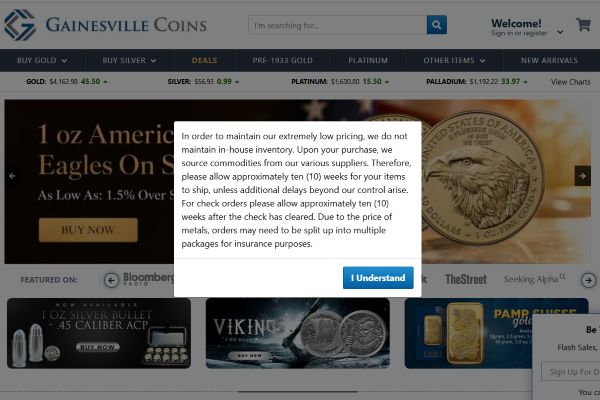
Gainesville Coins' website disclosure, captured October 15, 2026,
describes its sourcing model and approximately ten-week shipping estimate.
The company's published policies, updated April 7, 2026, describe a minimum ten-week processing period for certain purchases, excluding weekends, federal holidays and office closures. The applicable period may consequently extend beyond ten calendar weeks, depending on the transaction. An extended processing window does not automatically indicate unlawful conduct, but it makes the precise delivery commitment important. Buyers should understand when processing begins, whether merchandise is available and what remedies apply if the promised timeframe is missed.
How Gainesville Coins' Shipping Terms Compare
Gainesville Coins' extended fulfillment window stands out because there is no clear evidence of a widespread bullion shortage forcing dealers across the industry to operate on comparable timelines. Major retailers continue to advertise commonly traded gold and silver products as available for shipment within several business days after cleared payment, although specialty items and preorders can take longer. That contrast suggests Gainesville Coins' ten-week processing policy is more closely associated with its disclosed sourcing and fulfillment model than with an industrywide supply disruption. It does not, however, establish why any particular customer order was delayed.
That difference deserves consideration when comparing prices. A lower premium may be less attractive when accompanied by a lengthy fulfillment commitment, particularly if cancellation rights are limited. Buyers should compare product availability, shipping estimates and refund terms alongside price. Bullion Hunters' review of major bullion company collapses provides broader historical context for counterparty risk, without implying that Gainesville Coins faces comparable financial circumstances.
What the BBB Complaints Show
Gainesville Coins' Better Business Bureau profile displayed an F rating and 200 complaints over the preceding three years, including 68 within the previous 12 months, when reviewed October 15, 2026. The records include reports of delivery and communication difficulties, alongside some subsequent resolutions. Complaint totals can change, and neither a BBB complaint nor a business rating constitutes a legal finding of wrongdoing.
The evidence must be distinguished carefully. The Florida agreement documents regulatory commitments, the company's website establishes its published fulfillment terms, and the lawsuits describe disputed transactions. Together, these developments raise legitimate questions about delivery expectations and customer protections. They do not independently establish insolvency, missing assets or misconduct in every transaction.
What Bullion Buyers Should Verify Before Paying
Customers should distinguish between paying for bullion, receiving physical possession and holding metals through a dealer's storage service. Before ordering, buyers should confirm whether products are in stock, when shipping estimates begin and what happens if delivery is delayed. Retaining listings, invoices and written delivery promises helps document the original agreement.
Payment method also matters. The Consumer Financial Protection Bureau explains that certain credit-card billing disputes generally require written notice within 60 days after the statement containing the disputed charge was sent. A lengthy shipping estimate does not automatically extend that deadline. Storage customers should also verify whether holdings are allocated or pooled, who maintains custody, what insurance applies and how withdrawals are processed. These details can determine what rights customers have if they encounter delivery difficulties.
What Happens Next for Gainesville Coins?
As of October 15, 2026, the documented picture includes reported civil allegations concerning undelivered or unreleased precious metals, a previous Florida regulatory agreement and the company's continued disclosure of extended processing terms. Future rulings, settlements, regulatory actions or policy changes could alter the situation, and unresolved allegations should not be presented as proven wrongdoing.
For bullion buyers, the broader lesson is that the lowest advertised price does not always represent the best overall value. Researching dealer reputations, comparing premiums, verifying product availability, and understanding shipping timelines, payment protections, and storage arrangements are all essential before making a purchase. That is precisely why Bullion Hunters exists: to help buyers compare precious metals dealers, evaluate pricing and purchasing terms, and make informed decisions with greater confidence. In a market where trust and transparency matter as much as price, doing your homework can make all the difference.
Frequently asked questions
Why is Gainesville Coins facing lawsuits?
Customers have filed civil claims alleging that precious metals they purchased or placed in storage were not delivered or released as requested. An October 9, 2026 Tampa Bay Business Journal report described nine investor complaints. The lawsuits involve different transactions and requested remedies, so their allegations should not be combined into a single account. A complaint represents a plaintiff's claim, not a finding that the defendant committed wrongdoing. Individual case outcomes require verification.
Does Gainesville Coins have a ten-week shipping policy?
Gainesville Coins' website displays a disclosure asking customers to allow approximately ten weeks for shipment, explaining that it sources products from suppliers after purchase rather than maintaining in-house inventory. Its April 2026 terms also describe a minimum ten-week processing period for certain purchases, excluding weekends and specified closures. Actual timing depends on the applicable transaction terms and payment clearance. Customers should review those provisions and retain their original order confirmations and delivery estimates.
What did the Florida Attorney General agreement require?
A September 2025 Assurance of Voluntary Compliance addressed earlier consumer complaints involving Gainesville Coins. According to the BBB's government-action summary, the agreement required clearer disclosures concerning the company's broker status, merchandise availability, delivery estimates and refunds. It also addressed delayed-order notifications, customer-response requirements and a $50,000 payment toward consumer relief and related costs. The agreement should not be confused with a judicial finding that every complaint was valid or that later conduct violated its terms.
Does a lawsuit mean Gainesville Coins has been found liable?
No. Filing a civil lawsuit initiates a legal process in which plaintiffs present allegations and seek relief. The defendant may dispute those claims, and courts may consider evidence, motions and possible settlements before any final determination. Allegations involving Gainesville Coins should remain attributed to the plaintiffs unless a ruling independently establishes the relevant facts. Because the current disposition of every reported case has not been verified, it would be inaccurate to characterize all cases as either pending or resolved.
Are other bullion dealers also taking ten weeks to ship?
Shipping estimates vary by dealer, product availability and payment method. Some major retailers advertise common bullion products as available for shipment within several business days after payment clears. Specialty items, preorders and unusually large transactions can take longer. Gainesville Coins' published ten-week processing language should therefore be evaluated against comparable products and fulfillment arrangements, not treated as proof of a marketwide shortage or as the standard shipping period for all bullion dealers.
What should customers do if a bullion order does not arrive?
Customers should retain the order confirmation, payment record, promised delivery estimate and correspondence with the seller. They can request a written status update and review the applicable delay, cancellation and refund provisions. If payment was made by credit card, checking dispute deadlines promptly is important because certain protections depend on the date a billing statement was sent. Remedies may differ for checks, bank wires and storage agreements, so customers should verify which protections apply to their transactions.
What should customers verify before using dealer storage?
A precious-metals storage agreement should explain who owns the assets, whether holdings are allocated or pooled, how inventory is recorded and insured, and what procedures govern withdrawals. Customers should also establish whether the dealer stores the metal directly or uses another custodian. A purchase invoice may not describe every contractual right. The Gainesville-related storage allegations underscore the importance of retaining original agreements and understanding how and when physical delivery can be requested.